


Tuning Introduction for Modern Vespa at SIP Scootershop
Tuning Introduction for Modern Vespa at SIP Scootershop
Opinions differ when it comes to tuning the Modern Vespa. While some claim it's a waste of money, others meticulously familiarise themselves with the subject in order to get the best possible performance out of it. The fact is: Tuning a 4-stroke Engine is generally more complex and the price-performance ratio is somewhat higher than with a 2-stroke engine.
Modern Vespa: Getting started with tuning
In principle, a distinction must be made in the Modern Vespa sector between the respective cubic capacity and engine classes. The easiest and most efficient tuning is achieved with the air-cooled 2-stroke engines. With the 50 cc 4-stroke engines, tuning is a little more neglected. For Engines from 125 cc upwards, such as LEADER, LEM, iGet or the larger displacement class of 250/300 cc QUASAR/HPE, the world looks different, as more and more visions seem to be becoming reality.
Getting started is basically the same for all variator-driven Engines: De-throttling on 50 cc Models, sports vario and sports clutch including Clutch Bell and that's it for drive tuning. With 4-stroke engines in particular, you can achieve a significant optimisation of the drivetrain without having to spend a lot of money. If you want more, you have to venture into more complex engine tuning in the form of a Racing Cylinder, Camshaft and injection system.
How do I find the right tuning for my Modern Vespa?
You can now narrow down your search further. At the moment you are in the section for all Modern Vespas. However, you can also select the exact vehicle type above, for example "Vespa GTS/GTS Super/GTV/GT 60 250-300 ccm" and you will only be shown parts for these models. You can further refine the selection by selecting the filter, for example "Cylinder".

RESTRICTING
Commonly, 50 cc scooters are throttled by a Vario ring, constrictions in the air filter or in the inlet duct. In order to be able to maintain the 45 km/h maximum speed, they are also throttled by a speed limiter in the CDI.
Maximum models also have a speed limiter as standard. This is not in order to maintain a legal maximum speed, but as "life insurance" against uncontrolled revving of the engine, caused for example by a broken V-belt. Tuning CDIs also have a cut-off speed. However, this is somewhat higher than that specified by the manufacturer. Basically, dethrottling the vehicle or replacing the CDI is the prerequisite for further tuning steps.
VARIATOR/ CLUTCH/ CONVERTER/ GEARBOX
Up to the standard speed limit, optimising the drive is probably the easiest way to optimise the vehicle's performance. The additional speed achieved is marginal, but the increased fun factor due to improved acceleration and constant power clearly speak for optimising the drive.
Even replacing the V-belt, the complete variator such as the MALOSSI Multivar or simply the variator pulleys achieves noticeable differences. The drive tuning is rounded off by, for example, a MALOSSI Delta Clutch with optimised friction linings for less slippage or by replacing the converter unit.
If the vehicle is already at its top speed and you notice that there is still room for improvement, try replacing the gearbox and increasing the transmission ratio. You will be thrilled! If you are not sure about the composition of the drive components, we recommend that you use our drive tuning kits. Here we have put together simple and effective kits for you.
EXHAUST
While the exhaust system or the exhaust resonance plays a decisive role on 2-stroke scooters, it serves more as a sound level reduction on 4-stroke vehicles. The replacement of a 4-stroke system brings only a slight increase in performance compared to 2-stroke systems, also due to the different functioning of the two engines. The advantages of a 4-stroke scooter system are clearly in the area of acoustics!
CYLINDER/CYLINDER HEAD/VALVES/CAMSHAFT
By changing the cylinder, only the displacement is changed in the case of a 4-stroke engine, and the displacement and timing are changed in the case of a 2-stroke scooter engine. More displacement leads to more torque and more revs, consequently also to more power and a higher top speed. Of course, there are also differences in material. Standard cylinders are usually made of low-cost grey cast iron. Sport cylinders use aluminium. These cylinders have a shorter warm-up and start-up time, are more forgiving of jams and are much more efficient at dissipating heat than their cast iron counterparts.
Valves and the camshaft play an important role in 4-stroke engine tuning. Whereas with a 2-stroke cylinder the high degree of filling is achieved by wide overflow valves, with 4-strokes this has to be done by enlarged and flow-optimised valve disks and/or/also by a "sharp camshaft". With the MALOSSI Power Cam, for example, the cam radius is modified so that the intake and exhaust valves are open longer. An "All in One" system is found in the MALOSSI V4 Head. Massively enlarged valve disks promise up to 25% more power.


CARBURETTOR/INJECTION/LAMBDA/CDI
4-stroke carburettors are almost always so-called equal-pressure carburettors. Since 4-strokes generate very strong negative pressure on the intake side, the slide of a classic slide carburettor would be quite difficult to move in the part-load range. The diaphragm in the equal-pressure carburettor does this work for you, because it works with negative pressure. The rider merely moves the throttle valve in front of the throttle slide with the throttle cable.
Larger, or simply higher quality, carburettors increase engine performance. That is why we have all original carburettors and larger 4-stroke carburettors such as the MIKUNI TM33 flat slide with accelerator pump in our range. As with the 2-stroke, the carburettor must be tuned accordingly when the displacement is increased. Our tuning nozzle sets are therefore particularly practical.
With injection engines (i. e. injection), the fuel supply is regulated via the injection module. There is a difference between models with and without a lambda sensor. Modern Vespa injection engines over 125 cc are all equipped with lambda sensor. These engines do not need to be tuned for small changes. Based on the exhaust gas values, the Lambda control automatically balances the fuel quantity upwards. These values are set quite lean in order to comply with the exhaust emission standards. By installing a so-called Lambda Emulator, the standard parameters are expanded and one obtains a much more agile vehicle with better response behaviour during load changes.
With a massive increase in engine capacity, however, the original injection module and its defined parameters reach their limits. The only solution is to replace it with, for example, the adjustable MALOSSI Forcemaster2 injection module. Similar to a carburettor tuning, the fuel quantity can be adjusted manually. Lambda emulators can also be used!

The different models at Modern Vespa
Entry-level tuning
Inexpensive entry-level class. For anyone who only wants to install a few parts: better trigger, slightly higher top speed, more power. There is no increase in displacement.
Light variator pulleys MALOSSI
variator rollers Dr. Pulley
harder clutch springs MALOSSI
MALOSSI sports air filter
MALOSSI Torsion Control
Sport Tuning
Intended for the normal everyday rider who does not demand top performance, but wants to achieve more power on a durable basis with relatively little effort. Faster acceleration and more powerful on hills or in 2-man operation. Slightly higher top speed.
Sport variator
Sport V-belt
Sport counterpressure spring
Oil filter
Sport air filter/insert

We distinguish between four tuning classes
Einsteiger Tuning
Preisgünstige Einstiegsklasse. Für jeden, der nur wenig Teile verbauen möchte: Besserer Abzug, leicht höhere Endgeschwindigkeit, mehr Kraft. Es findet keine Hubraumerweiterung statt.
leichte Variatorrollen MALOSSI
Variatorrollen Dr. Pulley
härtere Kupplungsfedern MALOSSI
MALOSSI Sportluftfilter
MALOSSI Torsion Control
Sport Tuning
Gedacht für den normalen Alltagsfahrer, der keine Höchstleistungen fordert, sondern mit relativ wenig Aufwand mehr Leistung auf haltbarer Basis erreichen will. Schneller in der Beschleunigung und kraftvoller am Berg oder im 2-Mann Betrieb. Leicht höhere Endgeschwindigkeit.
Sport Variator
Sport Keilriemen
Sport Gegendruckfeder
Ölfilter
Sportluftfilter/Einsatz
Sport Plus Tuning
Hier baut man auf vorherige Tuningstufen auf. Zielgruppe ist der leistungshungrige Alltags- und Tourenfahrer. Der Umbau auf einen Sportauspuff und die Optimierung der CDI oder Benzineinspritzung wirkt sich deutlich auf die Charakteristik des Rollers aus. Agiler Abzug, schöner Durchzug und höhere Endgeschwindigkeit sind das Ergebnis dieser Umrüstung.
Sport Auspuffanlage
Sport Kupplung
Sport Kupplungsglocke
Lambda Emulator
Sport CDI
Einspritzmodul
Torque Drive
Sport Plus High End Tuning
Königsklasse - Hubraum statt Drehzahl. Die Tuningstufe „High End“ baut auf den vorherigen Stufen auf und ist nicht für Aufklebertuner gedacht. Hier erreicht man das Maximum an Leistung und Endgeschwindigkeit. Tuningerfahrung wird in dieser Tuningstufe empfohlen. Es ist ratsam, das komplette Sortiment zu verbauen, denn die Teile sind aufeinander abgestimmt!
Sport Zylinder
Sport Nockenwelle
Sport Ventile
Sport Ventilfedern
Sport Getriebeübersetzung
Sport Kurbelwelle
Getriebeübersetzung
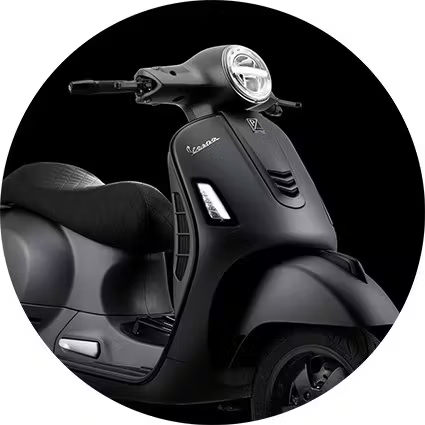
The best manufacturers for tuning with Modern Vespa



Malossi: Seit Jahrzehnten etabliert im Tuning für Scooter & Maxiscooter. Großartige Erfahrungen und Fortschritte im 4-Takt-Tuning, nicht zuletzt mit ihrer Rennserie für Modern Vespa Sprint.
Polini: Interessante, hochwertige und perfekt abgestimmte Produkte, nicht nur im Antriebsbereich.
J.Costa: Innovativer Vario-Antrieb welcher sich nach wie vor von der Konkurrenz absetzt.
Kunden fragen – SIP antwortet
„Lohnt sich das Tuning an der Modern Vespa überhaupt?“
Ich bin mit meiner serienmäßigen GTS 300 Euro4 den Großglockner kaum raufgekommen, als eingefleischter Motorradfahrer kann ich das so nicht auf mir sitzen lassen. Antriebstuning mittels POLINI Vario, Kupplung und Glocke war angesagt. Im Folgejahr hat sich das eigentlich überschaubare Tuning schon bezahlt gemacht, selbst bergauf konnte die GTS gut performen. Später waren dann natürlich noch die Bremsen fällig, denn wer schneller fährt muss auch besser bremsen können. (Sebastian B., SIP Mitarbeiter)
