


Full-face helmets and flip-up helmets - at SIP Scootershop
Full-face helmets and flip-up helmets - at SIP Scootershop
Full-face & flip-up helmets are particularly suitable for motorway, road or off-road use.
Full-face helmets
Whether for racing, motocross or everyday use - the full-face helmet offers the best protection in the various designs. The chin and face are covered and the material is extremely resilient. No wonder the term "full face" was invented for this type of helmet. Maximum safety, hardly any noise from outside and perfect aerodynamics. With a full-face helmet, you are on the safe side on any motorised two-wheeler. Especially the racers among the scooter fans cannot do without a full-face helmet.
The helmet shell has the crucial task of distributing the energy released in an impact over the entire helmet. The full-face helmets are subjected to extensive tests in our own test laboratories before they are even put on the market. However, not only safety but also weight must be taken into account. The materials used, such as fibreglass, GRP multifibre, carbon, polycarbonate and others, are therefore all the more important.
The obligatory visors are made of the same polycarbonate and are impact and shatter resistant. They are so cleverly designed that they keep the rain out but still provide fresh air at the same time. Other innovations are the Pinlock visors, which hardly allow the visor to fog up, and sun visors, which can also be attached to the main visor.
Meanwhile, it is no longer just the bombproof outer shell of an Intergral helmet that is important, but also the inner workings. Eyewear channels and communication systems are playing an increasingly important role.
Folding/modular helmets
If you love cruising and like to take a breath of fresh air, this mix of different helmets is perfect for you. The flip-up/modular helmet can be used like a jet helmet or you prefer the safety of the intergral helmet with all its advantages. This helmet is the perfect choice for almost all occasions and is one of the most popular on the market. This is because the freedom and flexibility mentioned above play a major role in the well-being of scooter and motorbike riders.
The flip-up helmet also offers a decisive advantage in the event of an accident, because paramedics and doctors can help more quickly by removing the visor. The visors, by the way, are replaceable and can simply be bought new when they wear out, without having to replace the whole helmet. So you can also save a few euros here. In the past, flip-up helmets were heavier than full-face helmets, but thanks to carbon and other materials, this is changing more and more. Comfort and safety go hand in hand in flip-up helmets.\
Our best brands for full-face and flip-up helmets
BANDIT

Made in Germany, Berlin. Since 1996, the cool company from Berlin has also been offering full-face helmets with wacky names such as "Alien", "Fighter" or "Super Street II". The company's roots lie in the street racer scene and the spacy helmets reflect this. Bandit doesn't produce run-of-the-mill full-face helmets, but aggressive looks and a sophisticated fit. The "Bandit XXR", for example, is now a true classic that would also look good on Darth Vader's head. Full-face helmets from Bandit make all the difference.
SHOEI

Absolutely top quality from Japan. The full-face helmets are not only made by hand, but Shoei also likes to make use of classics and give them a new lease of life. The "EX Zero Equation TC-2", for example, is clearly a homage to the 80s off-road scene. The retro look forms a symbiosis with state-of-the-art materials and Shoei has stood for uncompromising design for decades, designed for racers and true enthusiasts. High-end full-face helmets for riders and people who appreciate perfection.
BELL

Anyone who has been on the Formula 1 and Indycar scene for decades will probably know how to build perfect full-face helmets. Bell is also focussing on retro looks and repeatedly produces classics in a modern guise, such as the "Moto 3". Bell helmets are particularly popular with motocross and enduro riders, but not only. A classic scooter is also enhanced by a full-face helmet from Bell. With a full-face helmet from Bell, you are simply wearing a piece of history.
PIAGGIO

With the Racing Sixties Models, there is now a perfectly coordinated design for full-face helmets from the Italian cult manufacturer. This turns a ride on the Vespa into a complete visual package that is probably unique in this form.
HJC

The full-face helmets from HJC impress with their high level of comfort and offer an attractive price-performance ratio. Tested on many race tracks under professional racing conditions.
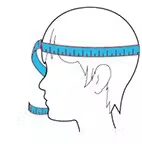
What size should my full-face helmet or flip-up helmet be?
The best way to measure the circumference of your head is with a Mesuring Tape. Place it about one centimetre above your eyebrows and then bring it back together at the back of your head. Compare the result with this table, then you will know pretty much exactly what size the full-face or flip-up helmet for men and women should be. Glasses wearers measure the circumference in the same way, but choose the size so that the Glasses do not pinch in the Helmet.
Ladies/Men
Head circumference | 50/51 | 52/53 | 54/55 | 56/57 | 58/59 | 60/61 | 62/63 | 64/65 |
Helmet size | XXS | XS | S | M | L | XL | XXL | 3XL |
Children
Head circumference | 49/50 | 51/52 | 53/54 | 55/56 |
Helmet size | XXXS | XXS | XS | X |
Rules of thumb for buying a full-face or flip-up helmet
The selected full-face or flip-up helmet should be worn for ten to 15 minutes to check comfort.
The helmet should fit tightly and not slip down the neck.
The head should have no slack in the full-face helmet, i.e. when you turn the helmet, the head should "go with it".
The straps of the fastener should not press against the neck but against the chin.
When the chin strap is closed, the helmet should not fall into the face.
If the glasses in the full-face or flip-up helmet press, another model should be chosen.
The cheek pads can be a little tighter at the beginning, because they give way by one to two millimetres over time. The forehead pads, on the other hand, are thinner and do not do this.
You can find more information about materials, care and more here.