
© Copyright: Vespa Tecnica - CLD LIBRI - SEC SRL

© Copyright: Vespa Tecnica - CLD LIBRI - SEC SRL
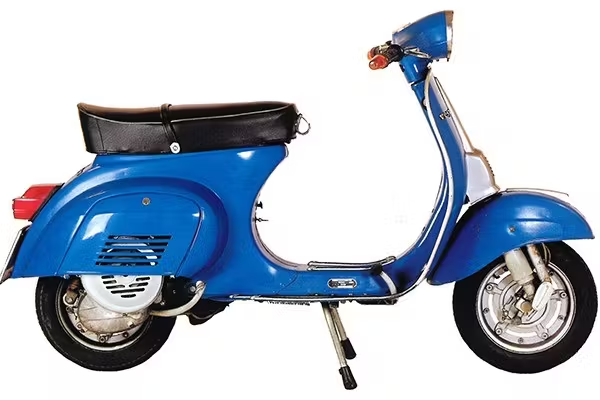
Compared to the Vespa 50 SS, the Vespa 50 Sprinter was more of a step backwards. While the 50 SS was characterised by its narrow Frame, the special narrow and lowered Handlebar, a unique Mudguard and a special Seat and also offered a Toolbox in the first series, the Sprinter returned to the standard bodywork of the V 50 N/S and only added a few Reinforcement Plates. It also used the same parts as the V50 for components such as mudguards and Handlebars.
The Vespa 50 SR appeared as the successor model to the Vespa 50 Sprinter. Its chassis was based on that of the V 50 Spezial, recognisable by the grey plastic cladding on the Legshield and the lack of a Glovebox Door on the Side Panel Trim. In contrast, the 50 SR used the Primavera's Handlebar with round Headlight Unit, Indicators on the handlebar ends and a small shell-shaped Speedometer. While the 50 Sprinter still had a sheet metal fairing, the 50 SR was characterised by the silver plastic fairing of the 50 Special.
In 1971, the Vespa 50 Sprinter was introduced as the direct successor to the Vespa 50 SS and was aimed in particular at the German market. It fell into the German vehicle class of mopeds at the time, which were limited to a maximum of 50 cc and 85 km/h, but was also popular in Austria and Switzerland. The Vespa 50 SR was the successor to the Vespa 50 Sprinter and, like the latter, was manufactured specifically for the German market.
The Sprinter's Engine, which was identical to that of the Vespa 50 SS but bore the prefix V5SS2M, had a Cylinder with sharper timing, a 16.16 Carburettor and a banana exhaust, allowing it to reach a maximum speed of 68 km/h. The 50 Sprinter was equipped with the cast iron Cylinder from the Vespa 50 SS, while the Vespa 50 SR was fitted with an aluminium cylinder from Gilardoni. With a top speed of 72 km/h, the 50 SR is regarded as the fastest 50 cc scooter with a 4-speed gearbox.
Licensed as a moped, the Sprinter had difficulties gaining acceptance among young people, who primarily favoured mopeds with a motorcycle-like appearance. This, together with the short production period, led to very low production numbers, which makes the Sprinter a rare vehicle today. It should therefore be of particular interest to collectors of Piaggio's sports models. Only 579 of the Vespa 50 SR were produced, making it one of the rarest models in Vespa production. Where do you look for this vehicle?
At your trusted Vespa dealer
Classified adverts in the local newspaper
Markets and trade fairs such as Mostra Scambis in Italy
Online marketplaces such as www.mobile.de, www.autoscout24.de etc.
Location of the frame number: The Italian frame number is located in the frame fold under the engine flap, while the decisive German frame number is attached to a narrow, oval metal plate at the end of the right footboard.
Lettering and logos: The front of the Legshield features the "Vespa" lettering in italics, followed by the Piaggio hexagon logo at the top of the Front Cover. A "sprinter" Sticker adorns the area on the right above the Rear Light on the frame fold.
Seating: The Vespa is equipped with a double seat for rider and passenger, the seat is black and features the "PIAGGIO" logo at the rear end. There is also a Luggage Hook on the Seat.
Mudguard: The mudguard is smooth and without the characteristic fin.
Speedometer: A round Veglia Borletti Speedometer with the hexagon logo, which displays speeds of up to 80 km/h.
Flywheel Cover: The cover of the Flywheel has a distinctive V-shape.
Rims: The Model uses closed rims, similar to those of the Vespa 50 N.
Rear Light: Two variants of the rear light were installed - the SIEM Antik small rear light with metal housing and a Reflector, surrounded by an aluminium frame, as already used on the Vespa 50 SS, and the "Rally" rear light, the roof of which is painted in the same colour as the Frame.
Frame number placement: The prefix and the number can be found on the upper frame rebate below the engine flap.
Logos and Badges: The "vespa" lettering adorns the front of the Legshield, complemented by the Piaggio hexagon logo on the plastic panelling. Above the Rear Light there is a Sign with the words "vespa 50s" and below it an "R" Sticker, with the Sign positioned higher than on other Smallframe Models to make room for the "R".
Seating: Equipped with a long Seat to allow operation with a passenger, it has a black saddle cover and a Luggage Hook.
Crankshaft: The crankshaft is fitted with a Needle Bearing in the connecting rod eye.
Speedometer: A Primavera speedometer from Veglia Borletti with a white dial that measures up to 100 km/h.
Rear lights: There are two variants - the "Rally" Rear Light with a roof painted in the frame colour and later the rear light of the Primavera ET3. Which version was fitted can be determined by the holes on the chassis.
Number plate holder: The number plate holder is painted in the same colour as the Frame and has a specific size.
Exhaust: The "banana exhaust", known from the 50/90 SS models labelled I.G.M.4307S, is in black.
Handlebar grips: The grip rubbers feature a waffle pattern with the hexagon logo until around 1978, then a grooved pattern.
Position of the Rear Light: Due to the larger licence plate, the Rear Light is mounted higher than on the 50cc models with insurance plates.
Colour | Colour Name | Max Meyer Code | Colour info |
 | Rosso 847 | 50 Sprinter | |
 | Rosso Corsa 806 | 1.298.5806 | 50 Sprinter |
 | Grigio | 8012M | Rust protection/primer |
 | Beige Versailles | 1.298.2580 | 50 SR |
 | Azzurro cina | 1.298.7402 | 50 SR |

Our online exploded views for scooters make it much easier for you to find the right part. Each item is assigned exactly to the corresponding vehicle, with year of manufacture and chassis number. From our Expo lists, you can navigate directly to the spare parts, where a photo and a description are then available for almost every part. Conversely, you can also navigate from the item detail to the corresponding exploded view.

