
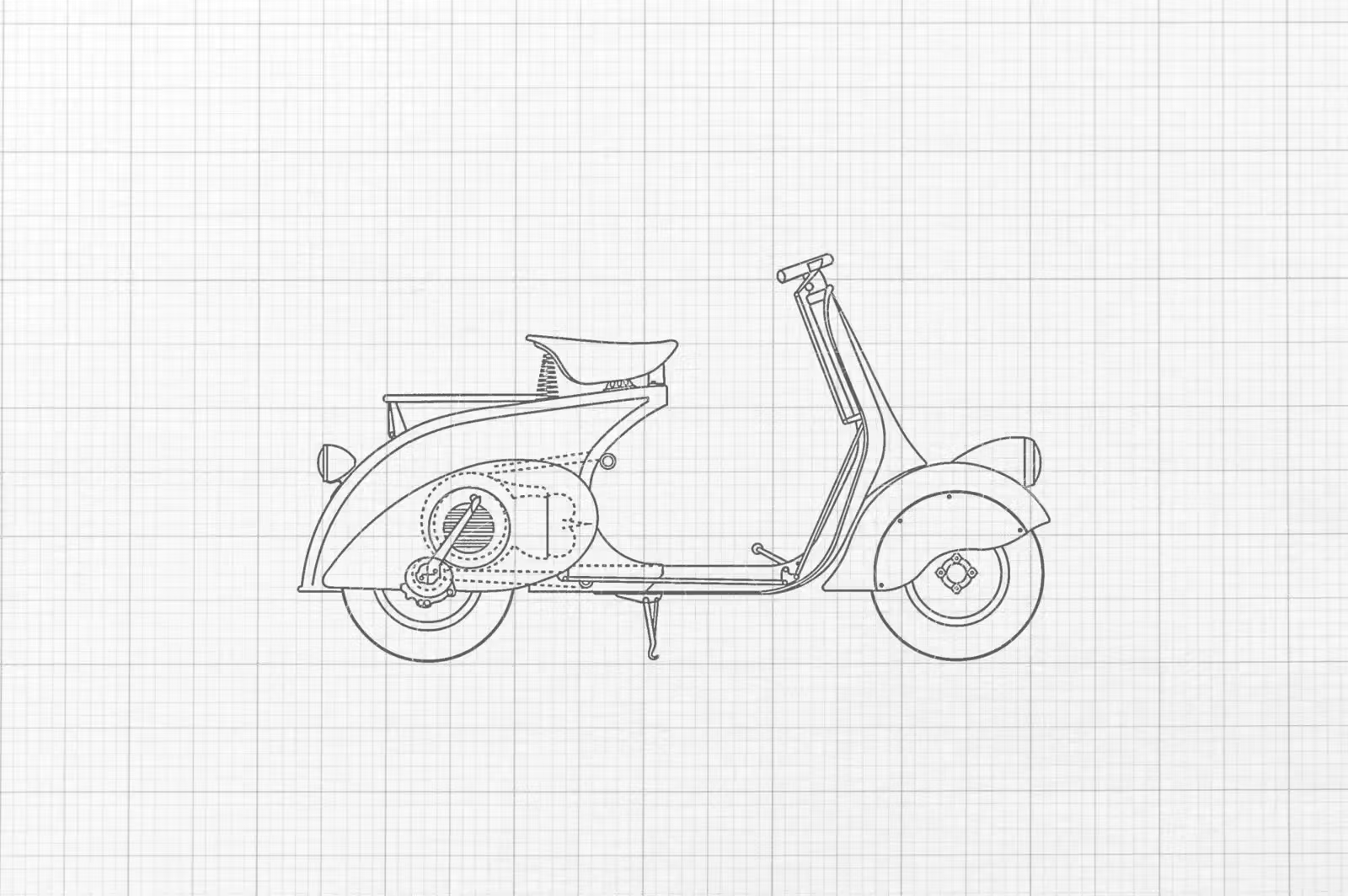

The Motovespa 150 GS was the Spanish licence version of the famous Piaggio "Gran Sport". It was manufactured exclusively for the Spanish market and was never officially exported. With its 145.5 cc two-stroke engine, four gears and a real 100 km/h, it was considered one of the sportiest production scooters of the 1960s, even beyond the Pyrenees. The slimmer bodywork with narrow, elegant Legshield, 10-inch wheels and 6-volt battery ignition as standard are typically Spanish.
After the import ban on complete vehicles, Piaggio founded the production company Moto Vespa S.A. in Madrid in 1952. A 150 GS variant rolled off the production line there for the first time from around 1960. The chassis was given the prefix 04C (Engine: 04M) and differed in some details from the Italian VS series: the leg Sign was designed to be closer fitting and certain Frame Parts were already taken from the later 160/160GT. the last series appeared in 1967, recognisable from the outside by the chrome-plated Decorative Trims on the Mudguard and Side Panels; it is also the rarest and most sought-after version. Motovespa replaced the GS with the more modern Sprint family as early as 1968, thus limiting the total production time of the Spanish GS to just under seven years.
The classic 2-stroke single cylinder with 57 mm bore and 57 mm stroke (145.5 cc) is at work inside. Compared to the Italian VS engines, the basic design remained the same, but Motovespa initially fitted the Dell'Orto UB 23 Carburettor and later, depending on the series, Spanish SHBC models. The power output is around 8 hp at 7,500 rpm, the torque just under 10 Nm. Characteristic - and still a challenge for Screw Engineers today - is the battery-assisted contact ignition: the Engine will not start without a charged 6 V lead-acid battery. Many models also have a Spanish Motoplat alternator, the spare parts for which are now only available from specialised dealers.
Because the scooters were never exported and Spain was economically isolated until the 1980s, relatively few GS 150s can be found outside the Iberian Peninsula today. Completely roadworthy but patinated examples are usually traded for between €10,000 and €15,000 in 2025. Originally restored pieces in factory paint or with a verifiable history quickly exceed the €20,000 mark; the final 1967 series with chrome trim often achieves a premium of 10-20 per cent thanks to its rarity. Decisive for the price are unmodified frame numbers(04C ...) and, on the engine side, the matching 04M stamping, the original 23 mm Carburettor and the large, so-called "fan-shaped speedometer". Where do you look for this vehicle?
At your trusted Vespa dealer
Classified adverts in the local newspaper
Markets and trade fairs such as Mostra Scambis in Italy
Online marketplaces such as www.mobile.de, www.autoscout24.de etc.
Some components are unique to this Model: the narrow, sporty Legshield (later also on the 160 GT), the small Brake Pedal of the Vespa 50S and specific Side Panel Doors with a wide bead for the chrome-plated trim strips from 1967. Paintwork was predominantly in "Argento Metallizado", although special Spanish colours appear occasionally. Spare parts are generally available from Italian and Spanish specialist dealers, but patience is required for body ribs, Speedometers and Motoplat Ignitions. Anyone who owns a Motovespa 150 GS is therefore not only holding an early sports scooter in their hands, but also a rare piece of contemporary history of Spanish Piaggio production.

Our online exploded views for scooters make it much easier for you to find the right part. Each item is assigned exactly to the corresponding vehicle, with year of manufacture and chassis number. From our Expo lists, you can navigate directly to the spare parts, where a photo and a description are then available for almost every part. Conversely, you can also navigate from the item detail to the corresponding exploded view.